• The phrase “merciless Indian savages”, penned by Thomas Jefferson in the U.S. Declaration of Independence, is one of the most widely recognized examples of how the United States government has described Indigenous peoples. Yet it is only one of countless dehumanizing terms that have appeared in federal records, laws, policies, reports, and correspondence over the course of U.S. history.

    Irreclaimable Savages is a project that documents these descriptors exactly as they appear in official government sources. Each entry will cite its original context to make visible the language that has shaped public policy, justified violence, and reinforced systems of removal, assimilation, and erasure.

    This is not a project about shock value. It is a project about evidence.

    Many continue to say, “This is not who we are.” But when we examine the archival record, phrase after phrase, document after document, it becomes undeniable that dehumanizing language has been a consistent and institutionalized feature of U.S. governance. The purpose of this site is to make that record accessible, searchable, and impossible to ignore.

    Dehumanization is not harmless rhetoric. When people are described as less than human, it becomes easier to justify their dispossession, their displacement, and their death. Language is not separate from policy; it prepares the ground for it. Naming that truth is the first step toward refusing its continuation.

    The title “Irreclaimable Savages” is taken from a term I encountered while researching Federal Indian Boarding School archives. It was one of many phrases applied to my ancestors, phrases buried in thousands of pages of official documentation, but still echoed today in subtler, normalized forms.

    I am a citizen of the Cherokee Nation. I am a PhD scholar, a researcher, a parent, a daughter, an aunt, a neighbor, a friend, and a stranger. Above all, I am a concerned citizen committed to public truth-telling. This work is meant to be shared, cited, taught, questioned, and expanded. The archive is not neutral, so neither is this project.

    May this site help us remember, and may remembering move us toward accountability, care, and collective repair.
  • Annual Report of the Commissioner of Indian Affairs for the year 1916, https://babel.hathitrust.org/cgi/pt?id=osu.32435064036098&seq=3

    Commissioner of Indian Affairs, Cato Sells, October 2, 1916.

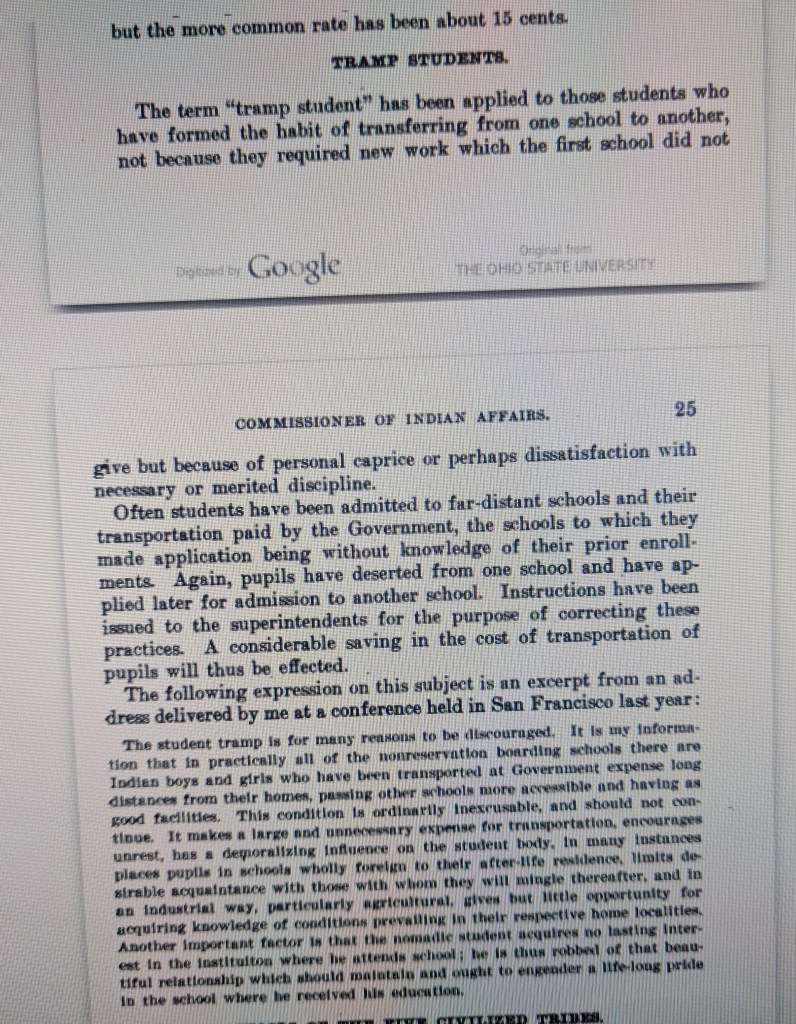
    “The term ‘tramp student’ has been applied to those students who have formed the habit of transferring from one school to another, not because they required new work which the first school did not give but because of personal caprice or perhaps dissatisfaction with necessary or merited discipline…

    …Again, pupils have deserted from one school and have applied later for admission to another school.

    Another important factor is that the nomadic student acquires no lasting interest in the institution where he attends school; he is thus robbed of that beautiful relationship which should maintain and ought to engender a life-long pride in the school where he received his education.” (pages 24-25)

  • In the Report of the Indian School Superintendent – Department of the Interior, Office of the indian School Superintendent, November 1, 1885 report:

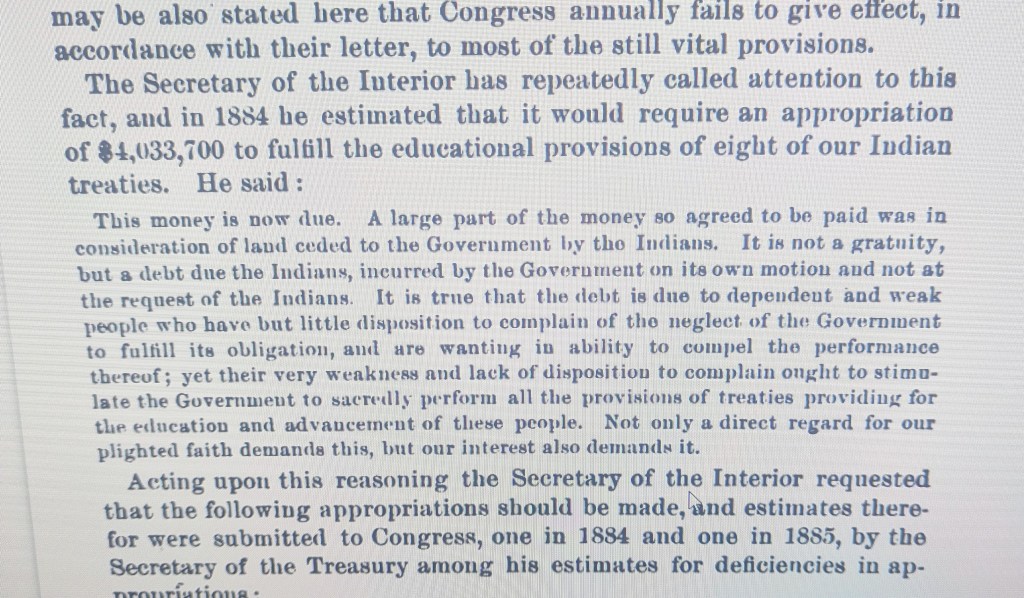
    The Secretary of the Interior, Henry M. Teller, called attention to the repeated failure of the government to provide educational provisions of eight treaties with multiple tribes:

    “It is not a gratuity, but a debt due the Indians, incurred by the Government on its own motion and not at the request of the Indians. It is true that the debt is due to dependent and weak people who have but little disposition to complain of the neglect of the Government to fulfill its obligation, and are wanting in ability to compet the performance thereof; yet their very weakness and lack of disposition to complain ought to stimulate the Government to sacredly perform all the provisions of treaties providing for the education and advancement of these people. Not only a direct regard for our plighted faith demands this, but our interest also demands it.” (page LXXXIII)

  • Annual Report of the Superintendent of Indian Affairs, 1831-32
    https://babel.hathitrust.org/cgi/pt?id=nyp.33433088715044&seq=17

    Governor Reynolds to General Clark
    Belleville, 26th May, 1831

    “The object of the Government of the State is to protect those citizens by removing said Indians peaceably if they can, but forcibly if they must. Those Indians are now, and so I have considered them, in a state of actual invasion of the State.

    As you act as the general agent of the United States in relation to these Indians, I considered it my duty to inform you of the above call on the militia, and that, in or about fifteen days, a sufficient force will appear before said Indians to remove them, dead or alive, over to the west side of the Mississippi…There is no disposition on the part of the people of this State to injure these unfortunate and deluded savages, if they will let us alone; but a government that does not protect its citizens deserves not the name of a government…. Your obd’t servant, JOHN REYNOLDS” (page 181)

  • Annual Report of the Commissioner of Indian Affairs, for the year 1894.

    https://search.library.wisc.edu/digital/A3YVW4ZRARQT7J8S

    Reports of Agents in Arizona; Chas. H. Cook, Missionary of the Presbyterian Church.

    “So far we have been unable to establish work on the Salt River Reservation and in the Quacharty and some of the Papago villages, where Indians still live in grossest heathenism.” (page 108)

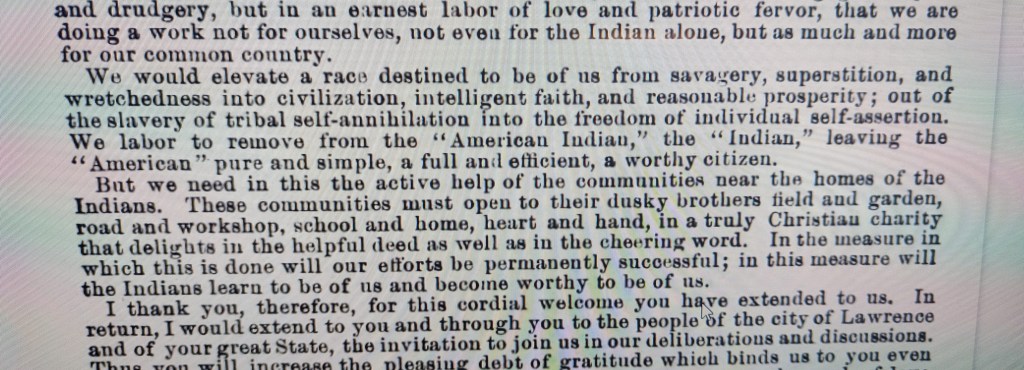
  • Report of the Superintendent of Indian Schools, 1896. https://catalog.hathitrust.org/Record/100075328

    Superintendent W.N. Hailmann

    “We would elevate a race destined to be of us from savagery, superstition, and wretchedness into civilization, intelligent faith, and reasonable prosperity; out of the slavery of tribal self-annihilation into the freedom of individual self-assertion. We labor to remove from the ‘American Indian,’ the ‘Indian,’ leaving the ‘American’ pure and simple, a full and efficient, a worthy citizen.” (page 26)

  • Annual Report of the Commissioner of Indian Affairs for the year 1898

    https://digitalcommons.csumb.edu/hornbeck_usa_2_e/30/

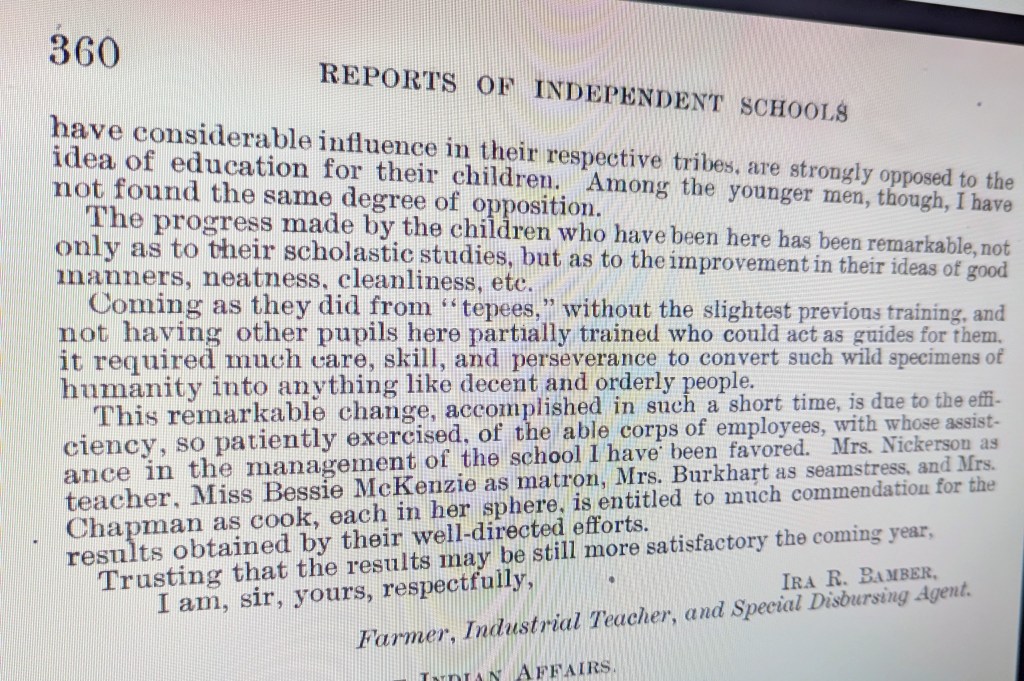
    Report of School at Fort Bidwell, CA from Ira R. Bamber, Farmer, Industrial Teacher, and Special Disbursing Agent , Fort Bidwell CA, August 20, 1898

    “Coming as they did from ‘tepees’ without the slightest previous training, and not having other pupils here partially trained who could act as guides for them, it required much care, skill, and perseverance to convert such wild specimens of humanity into anything like decent and orderly people.” (p. 360)

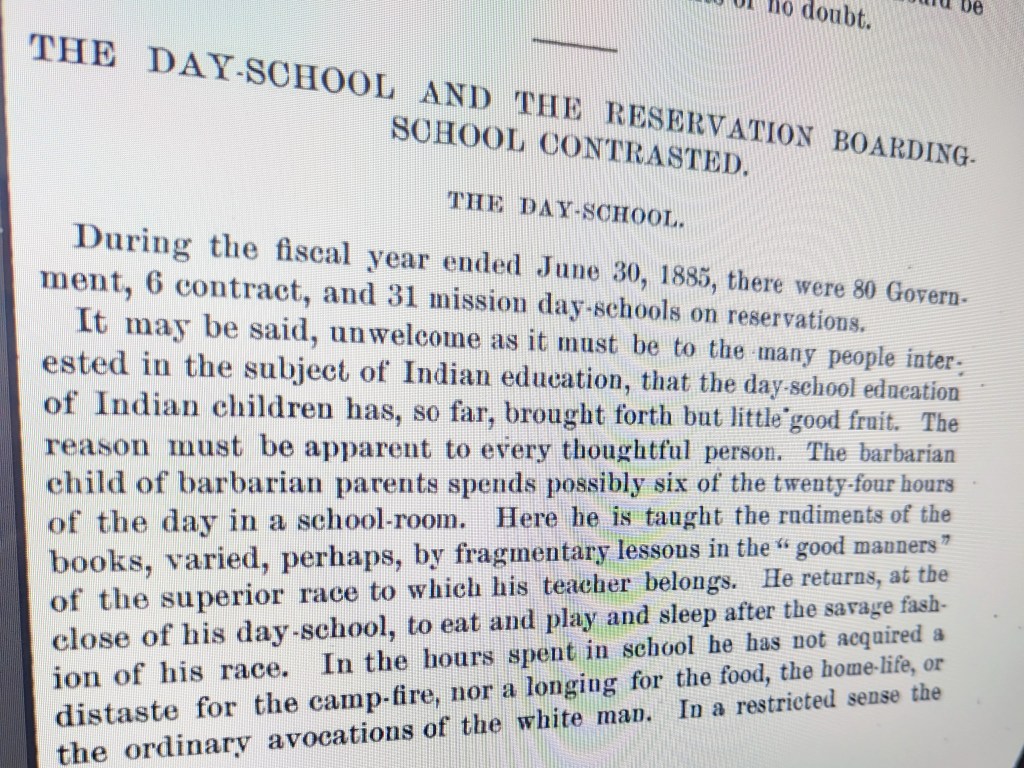
  • Annual Report of the Commissioner of Indian Affairs for the year 1885

    https://search.library.wisc.edu/digital/AC5UOFLSZHEGOL8A/pages/AXM4UOEM3FPCO38J

    Report of Indian School Superintendent and Statistics relating to Indian Schools, John H. Oberly, Indian School Superintendent (p. CXXVII)

    “It may be said, unwelcome as it must be to the many people interested in the subject of Indian education, that the day-school education of Indian children has, so far, brought forth but little good fruit. The reason must be apparent to every thoughtful person. The barbarian child of barbarian parents spends possibly six of the twenty-four hours of the day in a school-room. Here he is taught the rudiments of the books, varied, perhaps, by fragmentary lessons in the ‘good manners’ of the superior race to which his teacher belongs. He returns, at the close of his school day, to eat and play and sleep after the save fashion of his race.  In the hours spent in school he has not acquired a distaste for the camp-fire, nor longing for the food, the home-life, or the ordinary avocations of the white man. In a restricted sense the day-school gives to the Indian child useful information, but it does not civilize him, because it does not take him away from barbarons life and put him into the enjoyment of civilized life – does not take him from the tepee into the house, and teach him to appreciate, by experiencing them, the comforts of the white man’s civilization (p. CXI).”

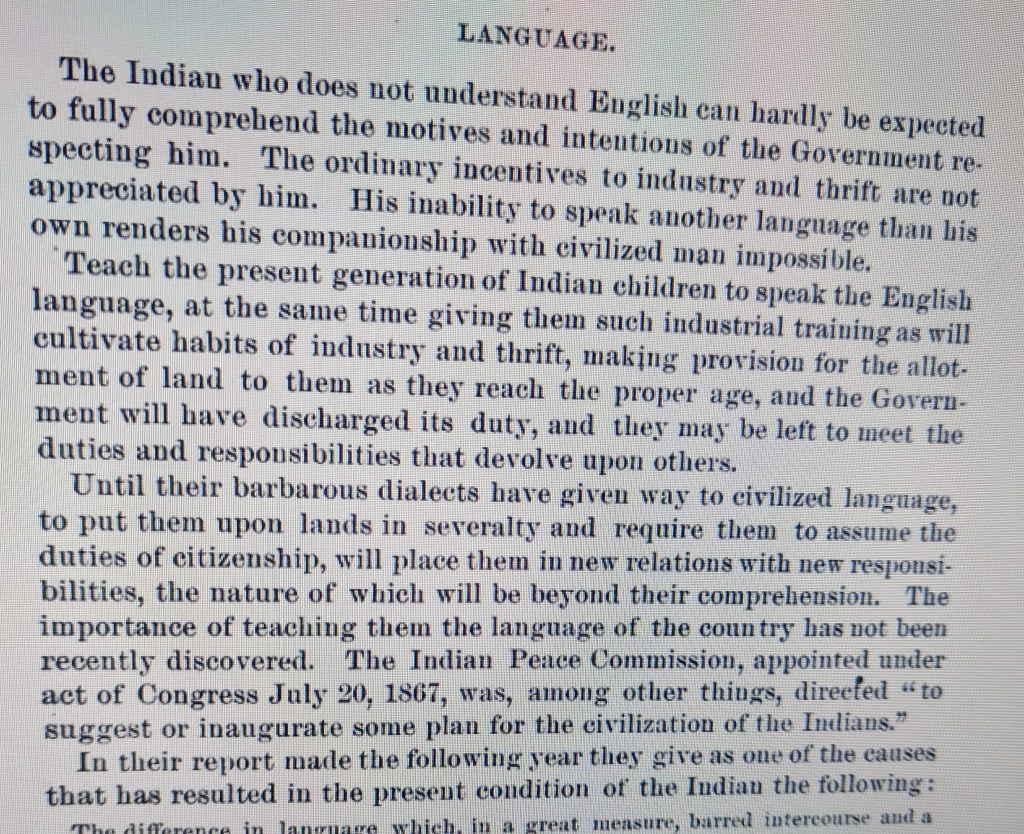
  • Annual Report of the Indian School Superintendent, 1887

    https://hdl.handle.net/2027/uiug.30112004022692

    Superintendent of Indian Schools: John B. Riley (p. 39)

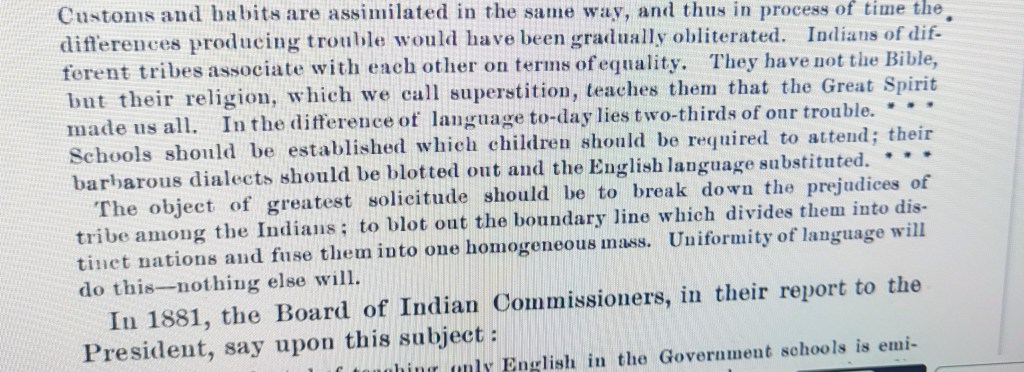
    “Until their barbarous dialects have given way to civilized language, to put them upon lands in severalty and require them to assume the duties of citizenship, will place them in new relation with new responsibilities, the nature of which will be beyond their comprehension.” (page 9)

    “Schools should be established which children should be required to attend; their barbarous dialects should be blotted out and the English language substituted.” (page 10)

  • Report of the Commissioner of Indian Affairs, accompanying the Annual Report of the Secretary of the Interior for the year 1857. URL

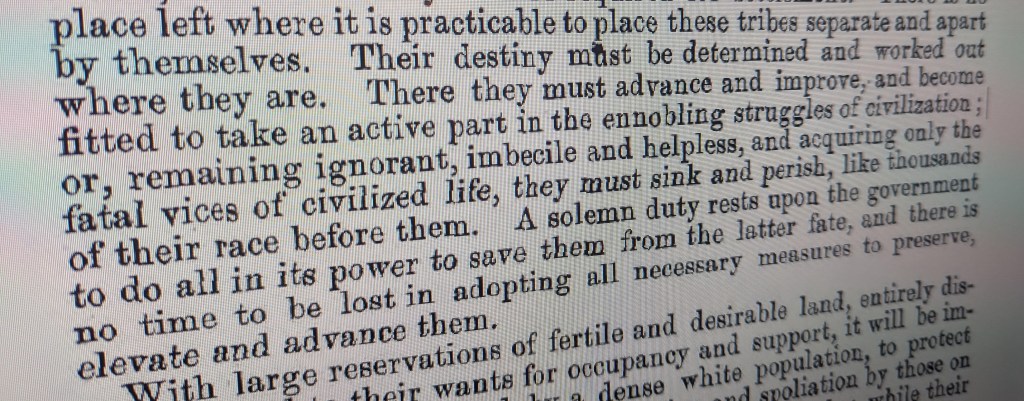
    “Their destiny must be determined and worked out where they are. There they must advance and improve, and become fitted to take an active part in the ennobling struggles of civilization; or, remaining ignorant, imbecile and helpless, and acquiring only the fatal vices of civilized life, they must sink and perish, like thousands of their race before them. A solemn duty rests upon the government to do all in its power to save them from the latter fate, and there is no time to be lost in adopting all necessary measure to preserve, elevate, and advance them.” (page 4)

    Written by:
    J.W. Denver, Commissioner
    J. Thompson, Secretary of the Interior (page 12)

  • Definition of barbarous, Oxford dictionary: Savagely cruel, exceedingly brutal; primitive and uncivilized

    “Annual Report of the Commissioner of Indian Affairs, 1900” History Collection, University of Wisconsin-Madison Libraries. https://digital.library.wisc.edu/1711.dl/3YVW4ZRARQT7J8S

    “If we would be successful in our work, the Indian child must be placed in school before the habits of barbarous life have become fixed, and there he must be kept until contact with our life has taught him to abandon his savage ways and walk in the path of Christian civilization.

    Instead of roaming with parents, riding wild ponies, sitting by railroad stations – favorite places of amusements – learning the white man’s vices around saloons, etc., the children, if in school, would have the example of right living in present and past history daily set before them, and would be taught to look upward for their ideals, to have a right appreciation of life, and respect and obedience for constitutional authority.” (page 426)