• Definition of barbarous, Oxford dictionary: Savagely cruel, exceedingly brutal; primitive and uncivilized

    “Annual Report of the Commissioner of Indian Affairs, 1900” History Collection, University of Wisconsin-Madison Libraries. https://digital.library.wisc.edu/1711.dl/3YVW4ZRARQT7J8S

    “If we would be successful in our work, the Indian child must be placed in school before the habits of barbarous life have become fixed, and there he must be kept until contact with our life has taught him to abandon his savage ways and walk in the path of Christian civilization.

    Instead of roaming with parents, riding wild ponies, sitting by railroad stations – favorite places of amusements – learning the white man’s vices around saloons, etc., the children, if in school, would have the example of right living in present and past history daily set before them, and would be taught to look upward for their ideals, to have a right appreciation of life, and respect and obedience for constitutional authority.” (page 426)

  • “1899 – Report of the Commissioner of Indian Affairs for 1899, Part 1” (2017). US and Indian Relations. 51. https://digitalcommons.csumb.edu/hornbeck_usa_2_e/51

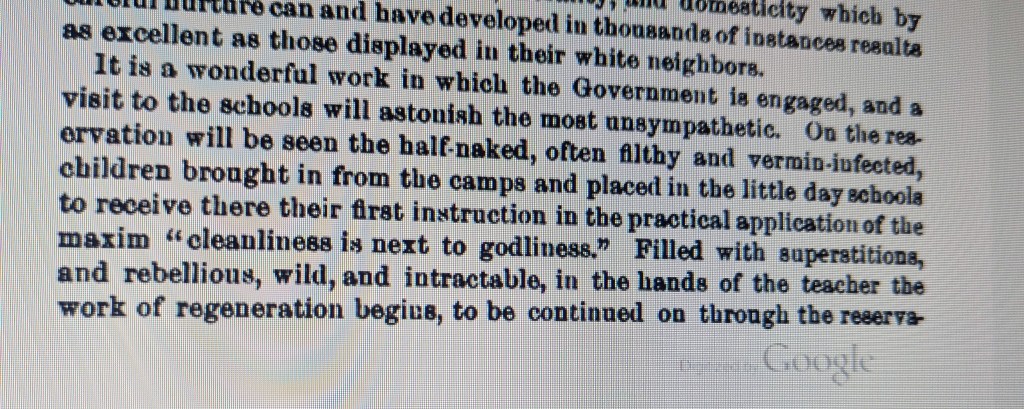
    “It is a wonderful work in which the Government is engaged, and a visit to the schools will astonish the most unsympathetic. On the reservation will be seen the half-naked, often filthy and vermin-infected, children brought in from camps and placed in the little day schools to receive there their first instruction in the practical application of the maxim ‘cleanliness is next to godliness.’  Filled with superstitions, and rebellious, wild, and intractable, in the hands of the teacher the work of regeneration begins…” (page 4)

    Intractable – hard to control or deal with (Oxford Languages)

  • The phrase “merciless Indian savages”, penned by Thomas Jefferson in the U.S. Declaration of Independence, is one of the most widely recognized examples of how the United States government has described Indigenous peoples. Yet it is only one of countless dehumanizing terms that have appeared in federal records, laws, policies, reports, and correspondence over the course of U.S. history.

    Irreclaimable Savages is a project that documents these descriptors exactly as they appear in official government sources. Each entry will cite its original context to make visible the language that has shaped public policy, justified violence, and reinforced systems of removal, assimilation, and erasure.

    This is not a project about shock value. It is a project about evidence.

    Many continue to say, “This is not who we are.” But when we examine the archival record, phrase after phrase, document after document, it becomes undeniable that dehumanizing language has been a consistent and institutionalized feature of U.S. governance. The purpose of this site is to make that record accessible, searchable, and impossible to ignore.

    Dehumanization is not harmless rhetoric. When people are described as less than human, it becomes easier to justify their dispossession, their displacement, and their death. Language is not separate from policy; it prepares the ground for it. Naming that truth is the first step toward refusing its continuation.

    The title “Irreclaimable Savages” is taken from a term I encountered while researching Federal Indian Boarding School archives. It was one of many phrases applied to my ancestors, phrases buried in thousands of pages of official documentation, but still echoed today in subtler, normalized forms.

    I am a citizen of the Cherokee Nation. I am a PhD scholar, a researcher, a parent, a daughter, an aunt, a neighbor, a friend, and a stranger. Above all, I am a concerned citizen committed to public truth-telling. This work is meant to be shared, cited, taught, questioned, and expanded. The archive is not neutral, so neither is this project.

    May this site help us remember, and may remembering move us toward accountability, care, and collective repair.

  • Annual Report of the Commissioner of Indian Affairs for the year 1885: https://search.library.wisc.edu/digital/AC5UOFLSZHEGOL8A/pages/AXM4UOEM3FPCO38J

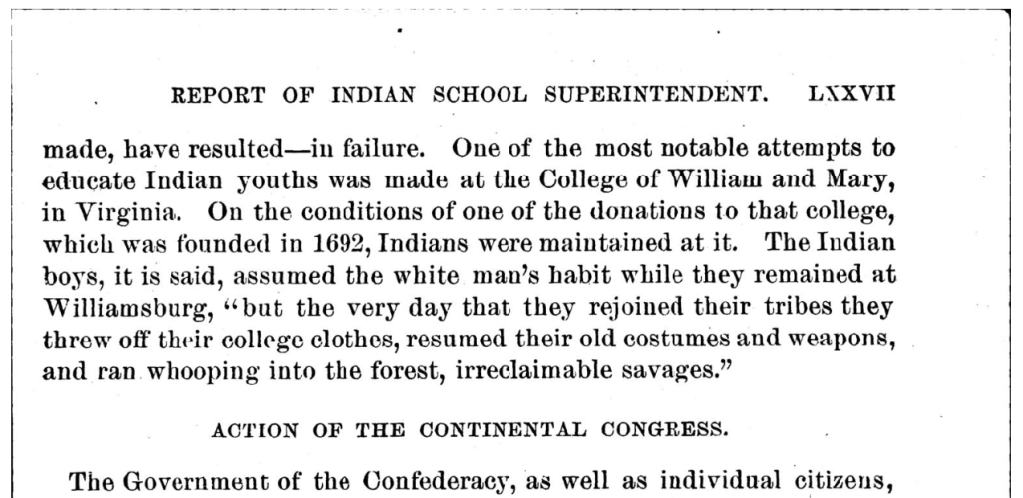
    “Before the Revolution charitable individuals attempted to educate Indian boys. These efforts were never successful. They resulted, generally, in the same manner that many of the Governmental efforts to educate Indian boys, made since that time – as many such efforts lately made, have resulted-in failure. One of the most notable attempts to educate Indian youths was made at the College of William and Mary, in Virginia. On the conditions of one of the donations to that college, which was founded in 1692, Indians were maintained at it. The Indian boys, it is said, assumed the white man’s habit while they remained at Williamsburg, ‘but the very day that they rejoined their tribes they threw off their college clothes, resumed their own costumes and weapons, and ran whooping into the forest, irreclaimable savages.’” (page LXXVI-LXXVII)